
Dear subscriber,
Indonesia’s modern coffee story used to be told through beans, baristas, and brand aesthetics. That framing is obsolete. In roughly eighteen months, the country’s leading chains have logged a run of milestones that belong to a technology sector, not a hospitality one.
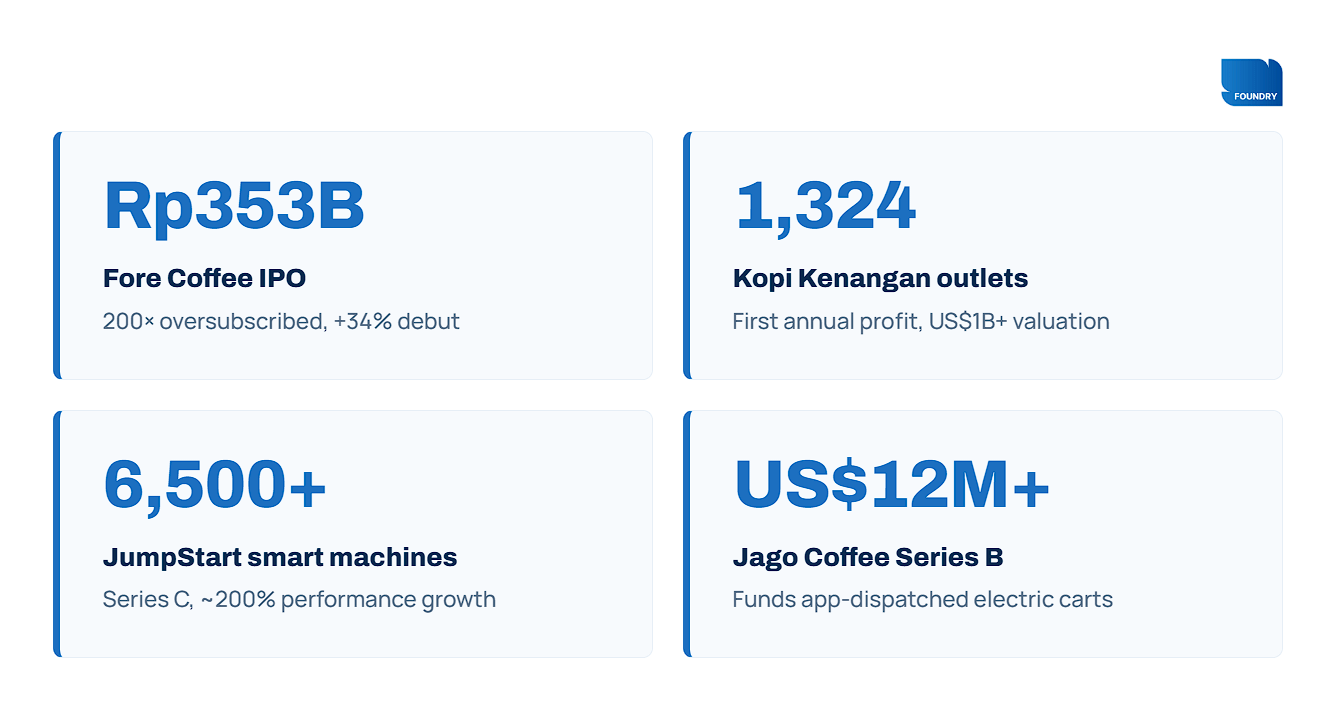
Fore Coffee listed on the Indonesia Stock Exchange. Kopi Kenangan booked its first full year of profit. JumpStart passed 6,500 networked machines and opened a new growth round. Jago Coffee closed a Series B for its app-dispatched electric carts.
Read together, they point to one shift: the operators that win Indonesian coffee now compete on digital infrastructure, not on the drink.
Stay sharp,
Foundry Collective
Indonesia Is Becoming a House of Coffee, on Both Sides of the Cup
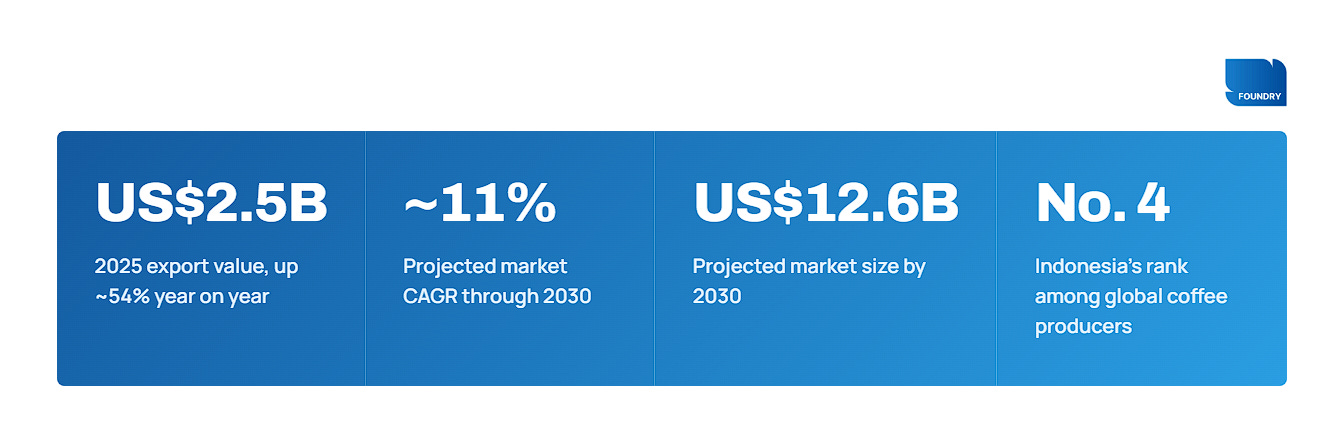
On the supply side, coffee became Indonesia's largest agricultural export in 2025, with shipment value up roughly 54% to US$2.5 billion. The country remains the world's fourth-largest producer, behind Brazil, Vietnam, and Colombia. On the demand side, domestic consumption is growing about 5% a year, among the fastest rates in Asia. Redseer projects the local coffee market to compound near 11% annually through 2030 toward roughly US$12.6 billion, with foodservice roast coffee, the format these chains operate in, expanding toward two-thirds of the total.
For investors, the case is structural: deep bean supply, a young urban consumer base, and a category still early on its monetization curve.
By 2024, Kopi Kenangan Operated 872 Outlets in Indonesia. Starbucks Held 567.
The reordering is not a single-brand story. Kopi Janji Jiwa runs roughly 900 stores and Tomoro around 600, each ahead of the chain that defined premium coffee in Indonesia for two decades. The mechanism is clear: homegrown brands built on es kopi susu, the iced milk coffee sweetened with palm sugar, priced near half of Starbucks and paired with grab-and-go formats and app-based loyalty.
Kopi Kenangan closed 2025 with about 1,136 outlets in Indonesia and 1,324 across six markets, a net 347 added during the year, close to one opening a day. It did so while turning its first annual profit, having pruned the side ventures that widened losses. Affordability democratized premium coffee. Discipline made it bankable.
The Asset-Light Retail Revolution
Menus are easy to copy. Ecosystems are not. What separates the winners is the software beneath the cup: loyalty programs that turn occasional buyers into data-rich regulars, machine-learning systems that pick expansion sites, and automated formats that cut the cost of every additional order. Physical coffee operations increasingly run on code. That is the trait now drawing capital, toward businesses that use software to run local, physical operations rather than purely digital products.
JumpStart, automated retail at scale
Founded in 2018 as a smart coffee-vending business.
Now runs 6,500+ AI-enabled, cashless machines across offices, malls, and public spaces.
Reported roughly 200% growth in financial performance in 2025.
Stepped up from Series B to a Series C led by Japan’s Cool Japan Fund.
The same logic is spawning entirely new retail formats across the sector. A vending network at this density is no longer a machine business. It is a distribution platform with software at the core, and every new unit sharpens the data that places the next one.
Jago Coffee, the asset-light, app-dispatched model
Dispatches baristas on electric carts through its own app, with coffee from about Rp8,000 a cup.
Runs a machine-learning layer that picks expansion sites.
Closed a Series B above US$12 million in early 2026, lifting total funding past US$20 million.
Jago has pushed furthest down the asset-light path: no storefronts, only app-dispatched carts and a software layer deciding where to send them next. It is the clearest case for the thesis that the operating system, not the storefront, is the business.
Fore Coffee, the public-market validation
Listed on the Indonesia Stock Exchange in April 2025.
IPO raised roughly Rp353 billion, oversubscribed more than 200 times by nearly 115,000 investors, and jumped 34% on debut, a striking result in a volatile market window.
Grew 2025 revenue roughly 42% to about Rp1.04 trillion.
Targets 600 outlets by 2030.
The Capital Signal: From Seed To Public Listing
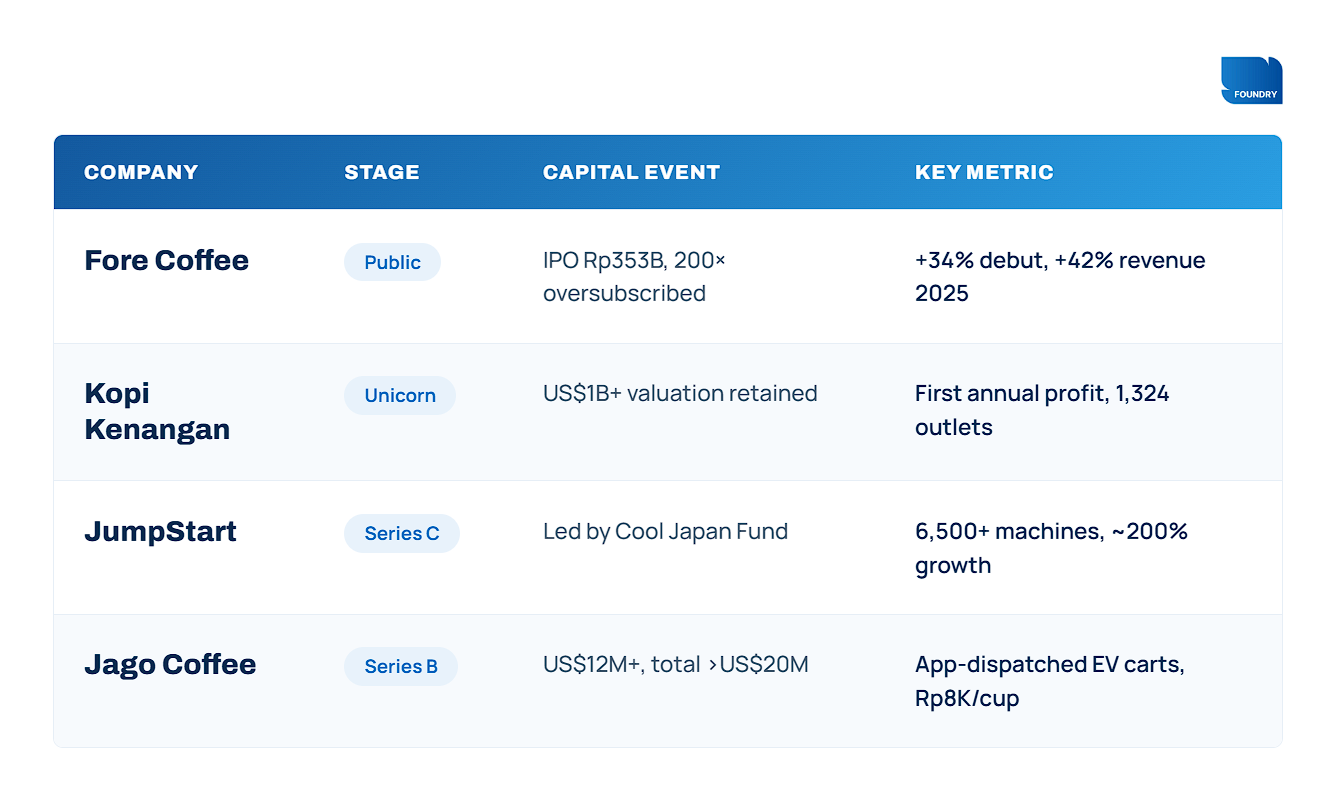
The financing signal now runs the full funnel. At the late stage, Fore’s IPO proved a working public exit for tech-enabled consumer chains. At the growth stage, Kopi Kenangan’s unicorn valuation and first profit show the category can reach institutional scale. At the venture stage, JumpStart and Jago both raised this cycle, confirming that early formation still feeds the pipeline. For allocators, the combination is what matters: a proven exit, a path to profitability, and steady deal flow from the next generation of operators.
The Investable Proposition Is No Longer the Drink. It Is the Infrastructure Underneath It.
Indonesia pairs the region’s largest population with a young, rapidly urbanizing, mobile-first consumer base — the demographic is the wind at these operators’ backs. The chains best positioned to compound are not those with the most distinctive latte, but those that own the loyalty data, the ordering rails, and the automated formats that lower the cost of serving each additional cup.
Several are already exporting the playbook: from Kuala Lumpur and Singapore to Manila and Sydney, with Taipei and the Middle East on the 2026 map. The model that scales across Southeast Asia is not a beverage brand. It is the digital and physical infrastructure beneath it.
A proven exit. A path to profit. A vending platform and a cart app still raising. Seed to listing, the whole funnel is lit. For allocators, that's the tell that matters: Indonesian coffee has graduated from a story about brands into a story about infrastructure — and the momentum is just getting started.