
Dear Subscribers,
Welcome to Foundry Digest, your weekly briefing from Foundry Collective.
In this edition, we examine why technology matters for Indonesia’s agricultural future, with a focus on execution, consistency, and ecosystem coordination. Drawing from insights shared by industry leaders, we unpack how AI and digital systems can strengthen real-world agricultural operations, support smallholder farmers, and build long-term competitiveness when grounded in practical implementation.
We also highlight case studies from Indonesia’s agritech landscape and key ecosystem developments shaping food resilience and innovation.
Stay ahead,
The Foundry Team
🚀 Tech-Driven Execution Seen as Key to Advancing Indonesia’s Agriculture
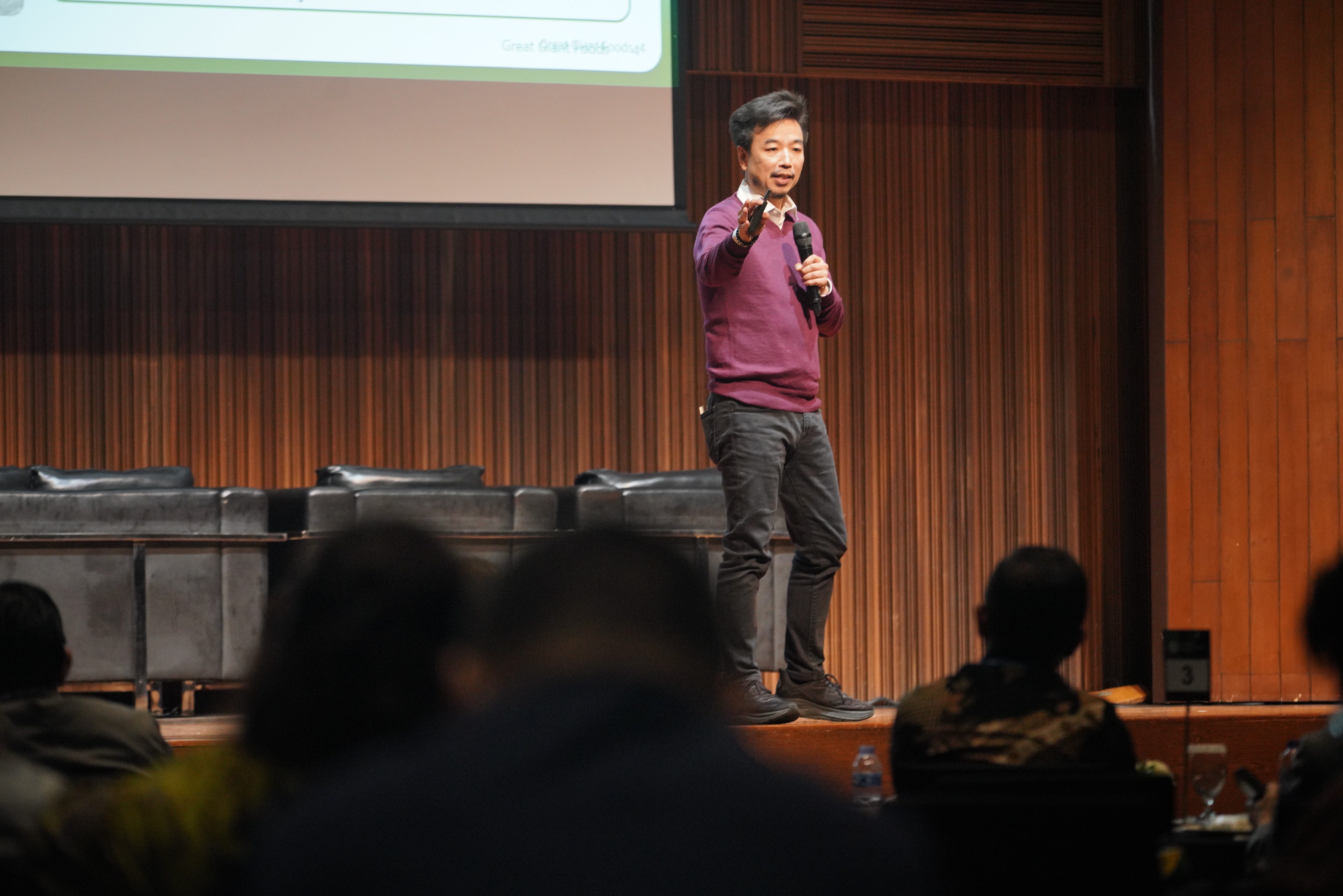
Strengthening execution and ecosystem coordination remains the most critical factor in advancing Indonesia’s agricultural sector, according to Tommy Wattimena, CEO of Great Giant Foods (GGF). While digital and emerging technologies like Artificial Intelligence (AI), Internet of Things (IoT) continue to evolve, their impact will depend on how well they are integrated into real-world agricultural systems.
Speaking in a discussion on food security and the future of agribusiness, Tommy highlighted that Indonesia’s challenges are less about innovation gaps and more about implementation, consistency, and coordination across the value chain.
“The opportunity is already there. The market exists, the natural resources exist. The real challenge is execution,” he said.
From Asset Ownership to Ecosystem Orchestration
Tommy noted that the traditional asset-heavy model of agriculture is becoming increasingly difficult to sustain. Limited land availability and fragmented ownership structures mean that future growth must rely on ecosystem orchestration rather than consolidation.
“Land is no longer abundant. We have to work with smallholder farmers, one or two hectares at a time,” he explained.
In this model, companies and startups are expected to act as coordinators, aligning farmers, supply chains, and markets rather than owning all production assets themselves.
Technology as Systems and Intellectual Property
In the discussion, technology was framed not as a single tool, but as a set of industrial and intellectual property–driven systems. These include seeds and genetics, biotechnology, ripening technology, and quality control mechanisms that enable consistency at scale.
“What matters is whether you have intellectual property and systems that can ensure quality and consistency,” Tommy said.
Such systems are seen as essential for building credibility in both domestic and global markets, particularly where Indonesia has struggled with supply reliability.
Consistency as the Core Competitiveness Issue
One of the most persistent constraints in Indonesia’s agriculture sector is inconsistency across production and distribution. According to Tommy, demand is not the limiting factor.
“Demand is not the problem, both locally and globally. Consistency is,” he said.
Addressing this requires tighter coordination across farmers, logistics, processing, and governance structures. Without this foundation, even advanced tools and digital platforms will fail to deliver lasting impact.
Agriculture as a Long-Term Discipline
Tommy also cautioned against applying digital startup growth logic directly to agriculture. Biological cycles, environmental risks, and human factors make rapid scaling unrealistic.
“Agriculture is a marathon, not a sprint. You cannot apply ‘fake it till you make it’ here,” he said.
He added that while technology can shorten learning cycles and improve efficiency, it cannot override the natural timelines of farming.
The Role of Digital and Emerging Technologies
Within this broader context, digital tools including data-driven systems and artificial intelligence can serve as supporting layers to improve decision-making and coordination. However, their effectiveness depends on ecosystem readiness.
“Technology must stay grounded. It has to work with farmers and real conditions on the ground,” Tommy emphasized.
Without strong farmer empowerment, infrastructure, and governance, technological adoption alone will not resolve structural issues.
Execution Over Hype
Looking ahead, Tommy stressed that Indonesia’s agricultural future will be shaped by its ability to execute at scale, empower farmers, and build resilient ecosystems.
“If we focus on execution and coordination, Indonesia is very well positioned,” he concluded.
The discussion reinforces a key message for policymakers, investors, and digital ecosystem players alike: technology, including AI, can amplify progress, but it cannot substitute for strong fundamentals, coordinated execution, and long-term commitment.
📊 How Digital Innovation Builds Food Resilience
The Food Resilience through Innovation and Technology report highlights the strategic role of digitalization in strengthening Indonesia’s food security, particularly through the agritech sector. It emphasizes that food availability is closely linked to agricultural efficiency and shows how local startups leverage technology and deep understanding of farmer needs to deliver practical, adoptable solutions across the value chain.
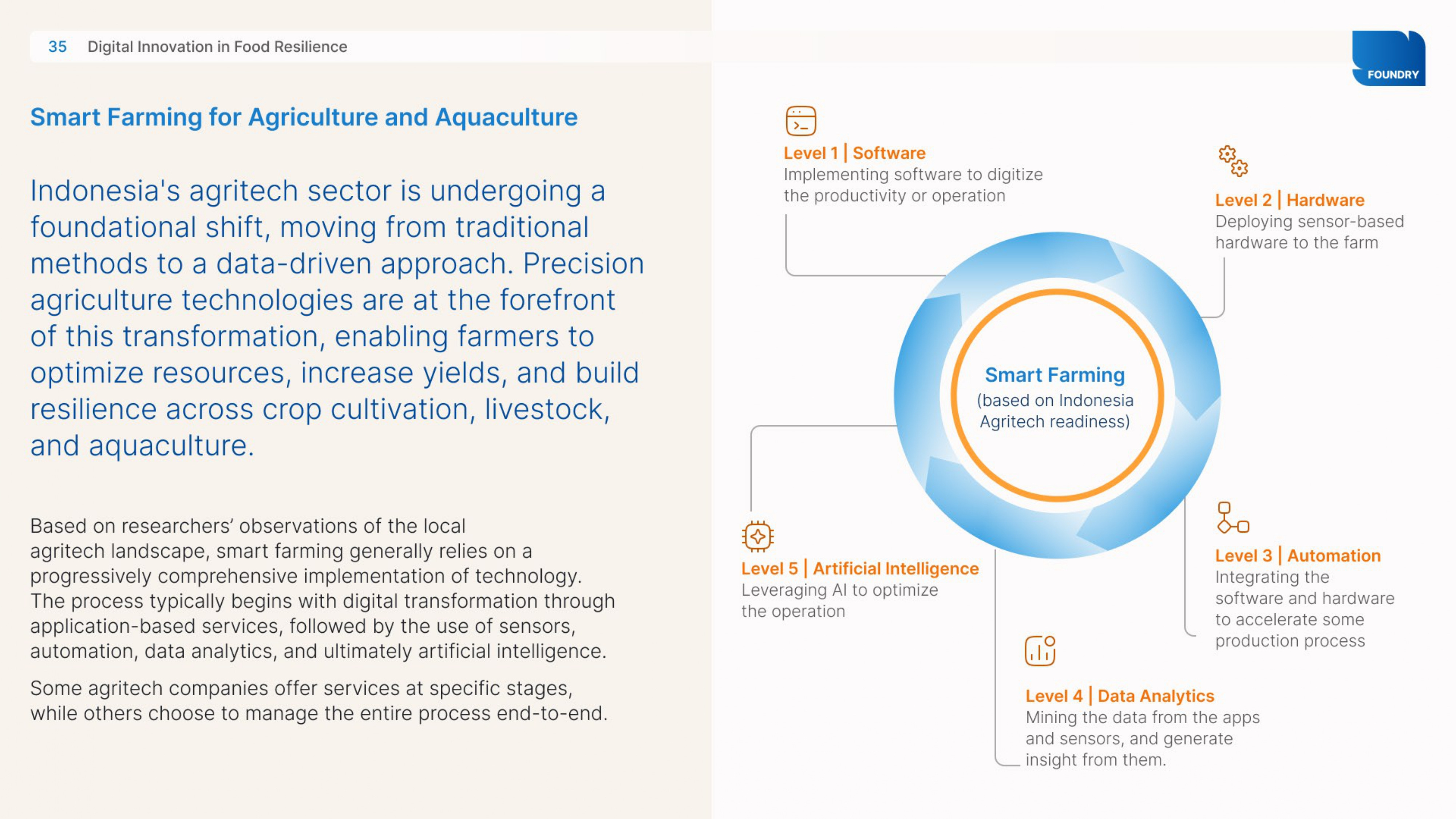
The report demonstrates that agritech is already generating measurable impact. Precision agriculture, IoT, automation, and artificial intelligence help reduce water and energy use, increase yields, and address labor shortages. These technologies confirm that digital innovation in agriculture is no longer experimental, but actively improving productivity and sustainability on the ground.
Several case studies illustrate this impact:
Agrari, shows how smart farming using soil and weather sensors can double yields and significantly improve crop quality while empowering smallholder farmers.
Eratani, presents an integrated agri-fintech and supply chain model that uses data-driven credit scoring and field-level support to improve farmers’ access to financing and ensure loan repayment.
Kreasi Pangan, highlights a strategic shift from a direct-to-consumer model to a B2B, logistics-first supply chain approach, focusing on building a sustainable and replicable commodity model before scaling.
Overall, the report concludes that long-term food resilience in Indonesia depends on pragmatic digital innovation, strong logistics foundations, and collaboration across the agricultural ecosystem.
Get more insight, download the report: Food Resilience through Innovation and Technology.⚙️ Industry Dynamics
Here are several significant developments across Indonesia’s ecosystem landscape that merit further attention.
Airwallex has acquired a majority stake in PT Skye Sab Indonesia, a Category 1 licensed payment service provider, to accelerate its expansion across Asia Pacific and strengthen its local payment capabilities in Indonesia. The acquisition allows Indonesian businesses to access Airwallex’s global financial infrastructure for cross-border transactions, while enabling international companies to more easily enter the Indonesian market. This move follows Airwallex’s recent US$330 million Series G funding round and underscores Indonesia’s strategic importance amid rapid growth in digital payments, e-commerce, and cross-border trade. [Read more]
Granite Asia has raised over US$350 million in the first close of its pan-Asia private credit fund, Libra Hybrid, with anchor commitments from Temasek, Khazanah Nasional, and Indonesia Investment Authority. The Singapore-headquartered firm, formerly GGV Capital Asia, is targeting US$500 million in total commitments as it expands beyond venture and growth investing into private credit. The strategy focuses on providing secured, non-dilutive financing to mid-sized Asia-Pacific companies pursuing growth and digital transformation, leveraging Granite Asia’s long track record in technology investing. [Read more]