
Dear subscriber,
Six years ago, fewer than 4 million Indonesians owned a stock. Today the number is 26 million — and growing. That is the market Stockbit and Ajaib were built for. In 2025, both platforms delivered the results to prove it.
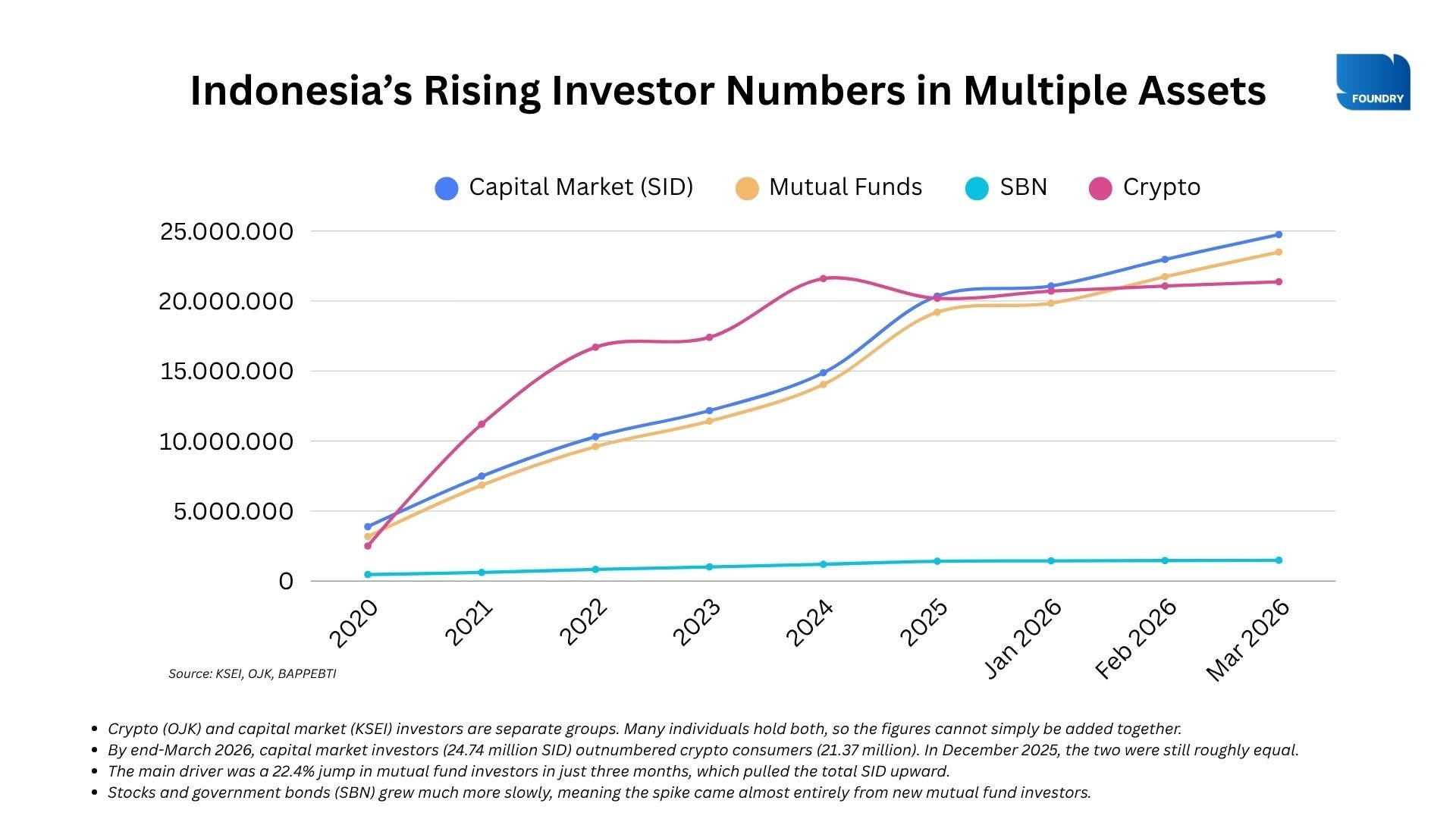
The lines above track registered investors across four asset classes from 2020 to early 2026 — and they do not plateau.
The initial surge was pandemic-driven: lockdowns pushed first-time investors onto mobile platforms, and zero-commission onboarding removed the cost barrier. What kept the lines rising was a compounding loop — OJK’s financial literacy campaign widened reach each year, wealthtech platforms continuously expanded their product shelf, and minimum investment thresholds pulled in income segments the traditional brokerage model had never reached.
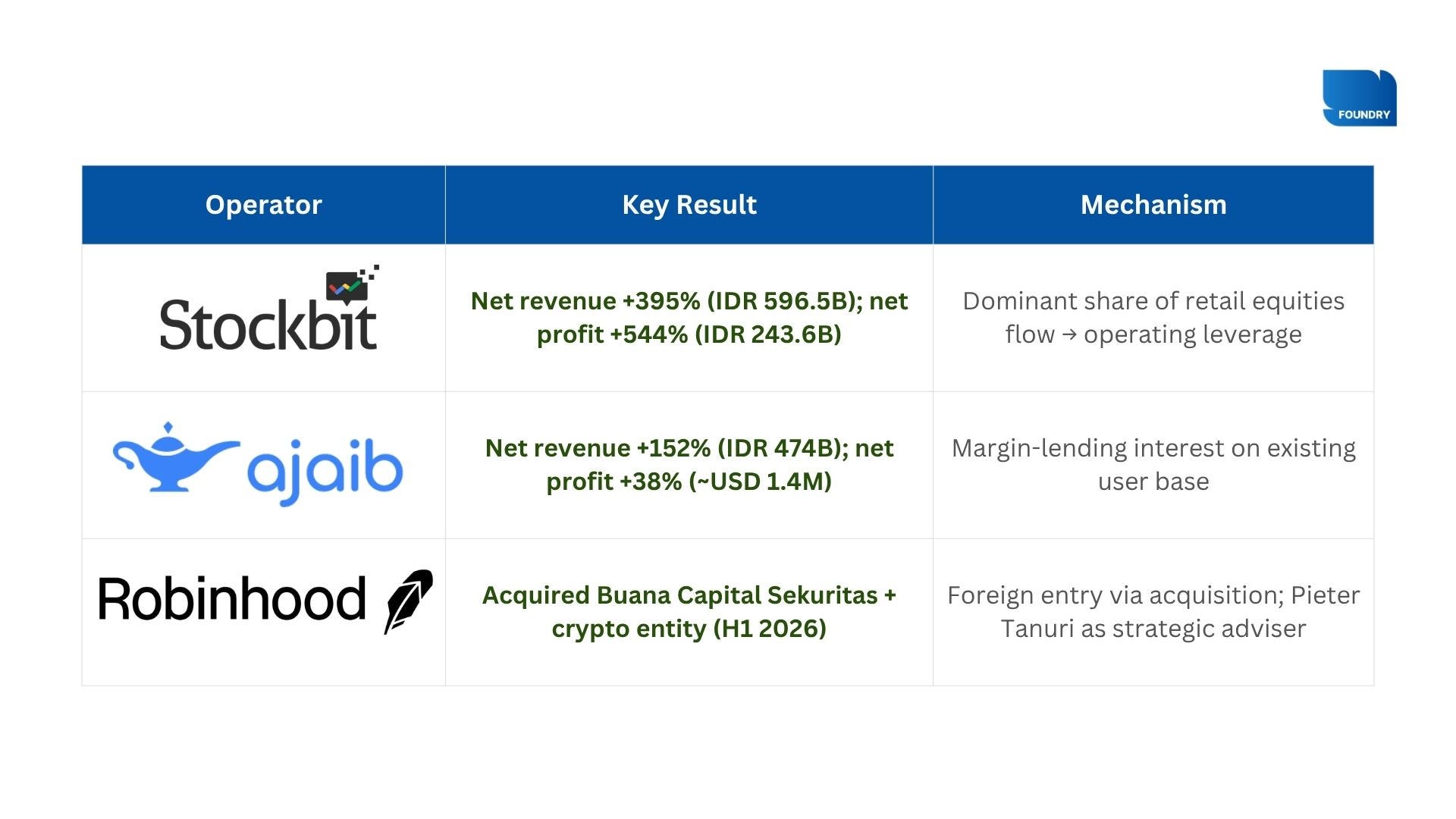
Stockbit posted net revenue growth of 395% and net profit growth of 544% — one of the most dramatic profitability prints in Indonesian tech this year. Ajaib grew net revenue 152% and crossed into profit for the first time. Furthermore, Robinhood, an US-based wealthtech app, announced it is acquiring Buana Capital Sekuritas and a related crypto entity to enter Indonesia. When the world’s most recognisable retail broker chooses to buy its way into your market, the validation doesn’t get more explicit than that.
Three operators. Three different positions on the same stack. All moving in the same direction.
Stay sharp,
Foundry Collective
The Setup
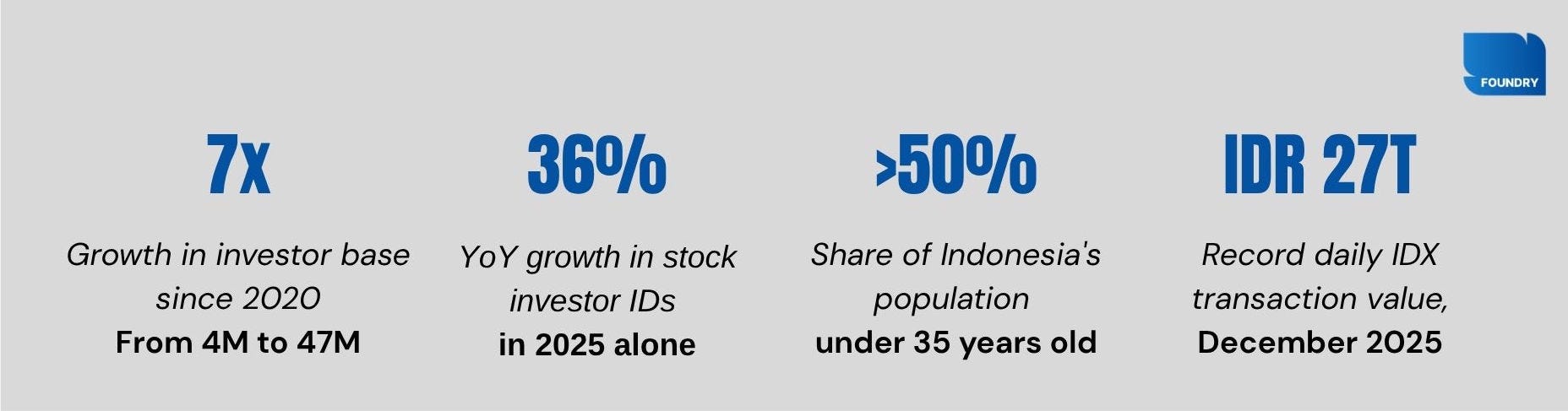
Indonesia’s retail investor base didn’t just grow, it compounded. From under 4 million stock investor IDs in 2020 to 26.8 million by Q1 2026, a 36% jump in a single year. Add 21 million registered crypto investors and the combined base hits 47 million. Daily IDX transaction value hit a record IDR 27.19 trillion in December 2025. More than half the country is under 35. Most have a smartphone before they have a savings account. This is the structural tailwind that Stockbit and Ajaib have been building for — and 2025 is the year it turned into earnings.
Stockbit: Capture the Flow, Then Let Operating Leverage Do the Rest
The Result
Full-year 2025 net revenue of IDR 596.5 billion — up 395% year-on-year. Net profit of IDR 243.6 billion — up 544%. Profit scaled harder than revenue because the fixed cost of building Indonesia’s dominant retail equities platform was already paid. What 2025 added was volume — and the platform converted that volume at a rate few operators in the region have matched.
The Mechanics
Stockbit spent years repositioning from social-trading community into the dominant execution layer for Indonesian retail equities. That repositioning was completed before this cycle began. The 2025 result is what operating leverage looks like when fixed costs are covered and volume accelerates.
Revenue scaled nearly 5x in a single year. Stockbit now commands a dominant share of Indonesia’s retail equities transaction flow — and every additional transaction hits a cost base that didn’t grow proportionally with it.
Profit grew faster than revenue. That gap is the operating leverage that only appears after fixed-cost coverage is cleared. The platform crossed that threshold and didn’t look back.
The market did the heavy lifting and Stockbit was positioned to catch it. Daily IDX transaction value hit IDR 27.19 trillion in December 2025. Stockbit’s share of that flow converted directly into margin at a rate that compounds with every new investor ID registered.
Indonesia added 7 million new stock investor IDs in 2025 alone (36% YoY increase). Stockbit’s onboarding cost did not rise proportionally. The cost of acquiring the next retail investor in Indonesia is still well below the lifetime value they generate. The 2025 print is what that gap looks like at scale.
Stockbit didn’t win 2025 because the market was good. It won because it spent years building the infrastructure to capture the market when it arrived — and the market arrived all at once.
Ajaib: Turn Your Existing Users Into a Lending Business. Then Watch the Margin Follow.
The Result
Full-year 2025 net revenue of IDR 474 billion, up 152% year-on-year. Net profit of approximately USD 1.4 million, up 38%. The first profitable year in the company’s history — delivered while aggressively reinvesting in growth. Operating expenses grew 171% and G&A grew 232% as Ajaib chased first-time millennial investors at scale. Profitability expanded anyway.
The Mechanics
Ajaib’s revenue story is not a commissions story. A significant and growing share of its top line now comes from interest income on margin facilities extended to customers Ajaib already owned. It is the same playbook GoTo’s fintech segment ran on its on-demand user base: build the audience with one product, then monetise it on a structurally higher-margin instrument. The acquisition cost was already paid. The margin lending is incremental.
Net revenue grew 152% to IDR 474 billion — led by interest income from margin facilities, not by commission compression on cash equities. The revenue mix shifted toward higher-margin instruments as the user base matured.
Profitability expanded even as the firm reinvested aggressively. Advertising and promotion more than tripled as Ajaib chased first-time millennial investors. The unit economics absorbed that spend and still delivered a profit. That is what a strong LTV:CAC ratio looks like in practice.
Ajaib didn’t build a separate lending business. It converted users it already had into margin-account holders — at marginal cost. That is the moat, and it is now visible in the revenue line.
Ajaib’s first profitable year arrived because it stopped treating its user base as a commission pool and started treating it as a lending opportunity. The margin was already there. It just needed the right product to unlock it.
Robinhood Is Buying In. That’s the Loudest Validation the Market Could Ask For.
The Result
Robinhood Markets announced the acquisition of Buana Capital Sekuritas and a related crypto-asset entity, targeting deal close in H1 2026. Pieter Tanuri, Buana’s long-time principal, stays on as strategic adviser — preserving local relationships and regulatory context that no foreign entrant can replicate from cold. This is the first marquee American broker to commit to the Indonesian retail market.
The Mechanics
Robinhood does not enter markets on hypothesis. The decision to acquire rather than build from scratch carries a specific message: the regulatory perimeter has cleared Robinhood’s internal threshold and the addressable market is large enough to justify the price of entry.
Acquisition is the fastest regulatory shortcut in a market where licences are the bottleneck. Buying an existing brokerage plus a crypto licence skips years of regulatory groundwork — and signals that Robinhood’s timeline for Indonesia is measured in months, not years.
The addressable market that attracted Robinhood: 26.8 million stock investor IDs, 21 million registered crypto investors, a mobile-first demographic that mirrors Robinhood’s US user base on every dimension that matters — age, smartphone behaviour, and retail-trading appetite.
Pieter Tanuri staying on as strategic adviser is not a courtesy title. It is the single most valuable asset in the deal — local relationships, regulatory familiarity, and market context built over decades that no foreign team can manufacture.
Robinhood’s arrival raises the competitive bar for every operator in the market. It also confirms the market is real. Both effects are already showing up before the deal closes — and both are bullish for Indonesia’s wealthtech sector overall.
When the company that democratised investing in America decides to buy its way into Indonesia, it is not making a bet on the future. It is confirming what the local revenue lines already showed: this market has arrived.
These Results Were Delivered Against a Demanding Backdrop — Which Makes Them More Impressive
The 2025 results didn’t arrive in a frictionless environment. MSCI flagged volatility on Indonesian equities in early 2026. Daily transaction value cooled from its record December 2025 peak. BI Regulation 10/2025 tightened compliance requirements for every licensed operator. And 29 OJK-registered crypto exchanges — plus a long tail of equities apps — are competing in the same space.
Stockbit posting 544% profit growth and Ajaib crossing into profit for the first time, inside that environment, is not luck. It is structural. The platforms that built the right mechanisms before the cycle peaked are the ones that held their margins when the easy volume pulled back. That is exactly what the 2025 numbers show.
The Structural Drivers Behind Every Number
The investor base grew from under 4 million in 2020 to 47.8 million combined stock and crypto IDs by Q1 2026 — roughly 7x in six years. Financial literacy has risen every survey cycle since 2019. The product shelf has widened every quarter: investors who once chose between a single mutual fund and a deposit can now buy fractional US shares, gold-backed tokens, and government bonds from the same app. More than half the country is under 35 — and most have a smartphone before they have a savings account.
These are not temporary tailwinds. They are structural compounders — and every platform that captures a piece of this investor base today is building an asset that appreciates as the base keeps growing.
THE SIGNAL FOR FOUNDERS AND INVESTORS
Stockbit’s IDR 243.6 billion and Ajaib’s USD 1.4 million are not high-water marks. They are the first profitable prints of a structural shift that still has years to run. The retail investor base grew 7x in six years and is still compounding. The product shelf widens every quarter. Foreign capital has moved from observation to acquisition. The next question isn’t whether the model works — it’s how big the winners get, and how fast the next cohort follows them through the same playbook.
Three Operators. One Direction. The Race Is Just Getting Started.
Stockbit and Ajaib built their operating mechanisms quietly, over multiple quarters, before the numbers made them visible. Robinhood’s acquisition is the trailing confirmation, not the leading signal. 2025 is the year those mechanisms surfaced all at once — and in the same direction.
The wealthtech platforms that win the next decade won’t be the ones with the most users. They’ll be the ones that figured out how to make every user worth more than the last — through margin lending, product depth, embedded finance, and the compounding loyalty of an investor base that is still, by any global standard, just getting started.
Indonesia’s investor base isn’t just growing. It’s compounding. The platforms that understood that first are now showing it in their earnings.