
Dear subscriber,
Southeast Asia’s logistics story used to be told through parcels, price wars, and raw volume. That framing is now too small. In a single quarter, the region’s delivery networks logged milestones that belong to a technology sector, not a haulage one.
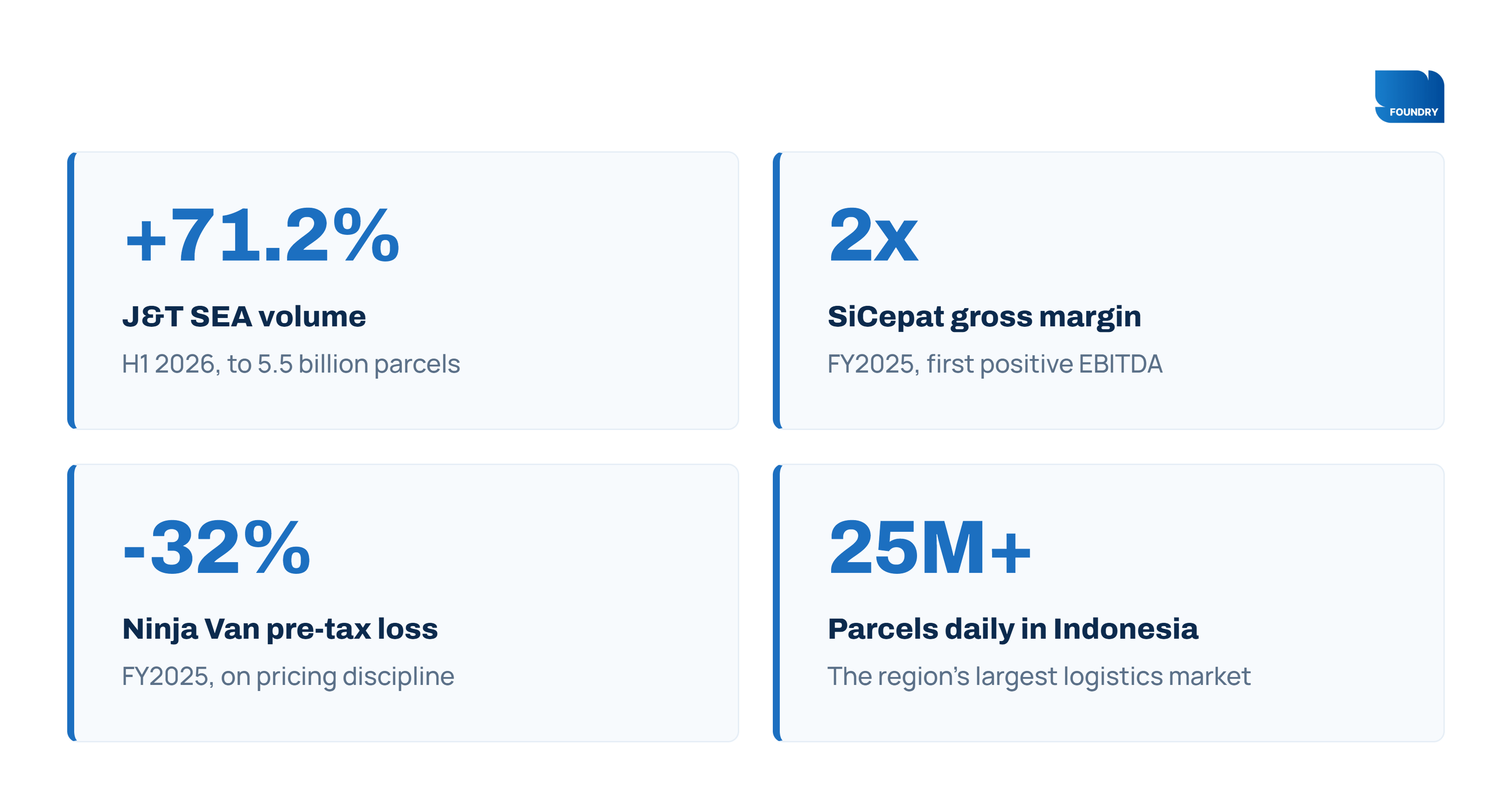
SiCepat Ekspres doubled its gross margin, posted its first positive EBITDA, and set a 25 percent growth target on top of it. J&T Express grew its first-half Southeast Asian volumes 71 percent and converted the surge into a doubled bottom line. Ninja Van cut its pre-tax losses by nearly a third by walking away from unprofitable volume. And the Indonesian state convened a national consolidation to strip cost out of the entire system.
Read together, they point to one shift: the operators that win Southeast Asian logistics now compete on efficiency, discipline, and network density, not on the parcel.
Stay sharp,
Foundry Collective
The Macro Layer
The regional backdrop is expanding, with ASEAN’s freight and logistics market on track from roughly US$306 billion this year toward US$406 billion by 2031, and Indonesia is its center of gravity. The country moves more than 25 million parcels a day, yet logistics still costs it close to 14 percent of GDP, with a 20 to 40 percent cost gap between Java and the outer islands. That gap is the single largest pool of value still on the table in Southeast Asian logistics, and it is closing. The state has signed eight DEAL packages convening shared infrastructure across carriers, and the largest operators are each attacking a different piece of the cost problem at once.
The Operators: One Thesis, Three Proofs
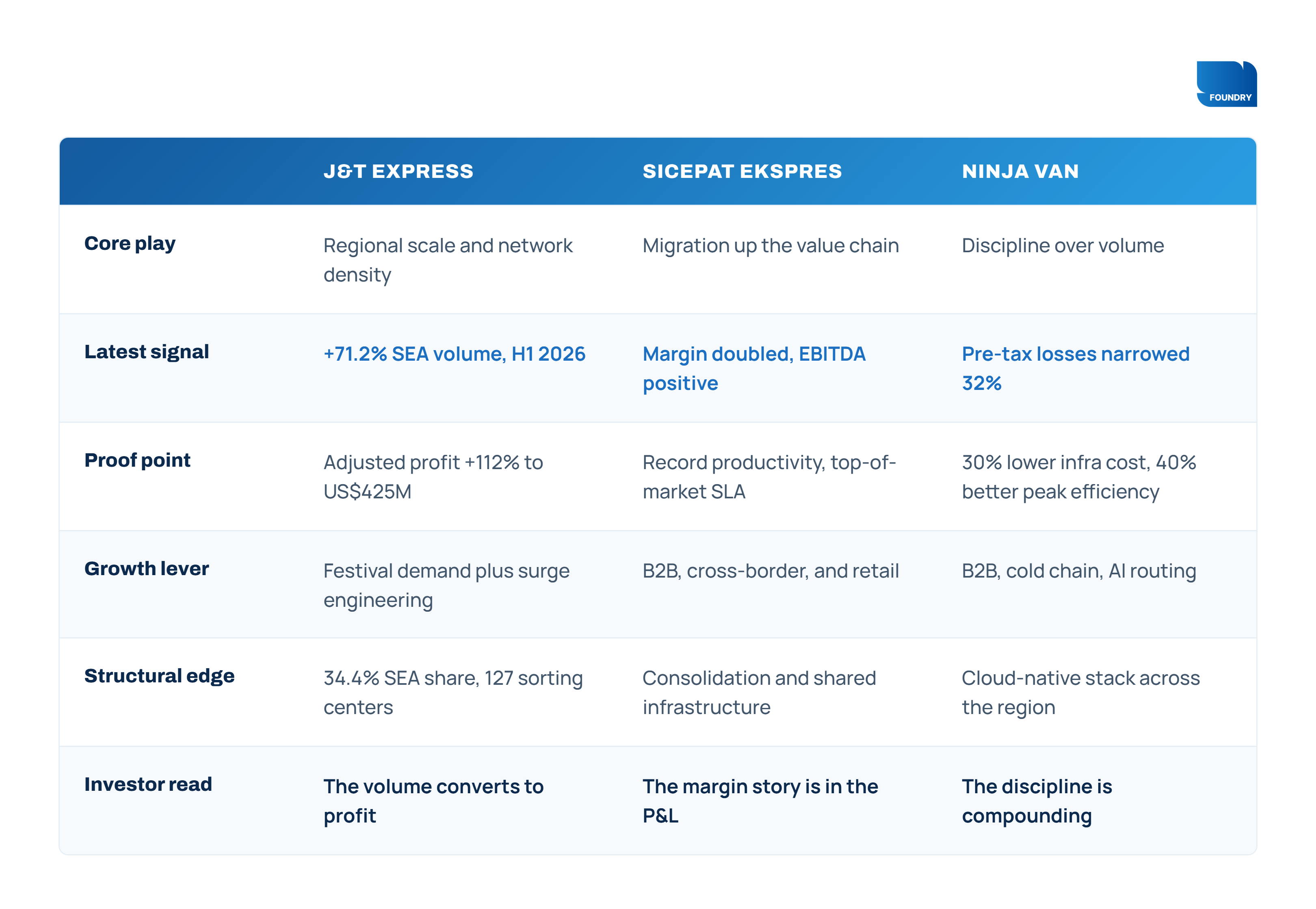
SiCepat is proving the value. J&T carries the volume. Ninja Van is proving the discipline. Every durable digital economy eventually grows a logistics layer strong enough to carry it. Southeast Asia now has one, and its clearest exponents are pulling in complementary directions: scale, margin, and discipline.
SiCepat Ekspres, the value migration, now in the numbers
Gross margin doubled year on year in FY2025, with gross profit doubling alongside it, and 2025 delivered the company’s first positive EBITDA.
Courier productivity hit record highs in December 2025 and again in February 2026, closing in on the company’s internal target, while SLA performance has held consistently at the top of the market since 2025.
Now targeting a 25 percent revenue increase in 2026 under CEO Barry Lim, led by a B2B engine of integrated supply chain, distribution, and custom logistics, a stronger retail network, and international shipping.
Each move points away from the thinnest-margin corner of the market. Commodity e-commerce delivery, after a decade of rate compression, is a volume game. B2B contract logistics and cross-border are value games, with stickier customers and real pricing power. The doubled margin and the EBITDA turn are the receipts: this climb up the value chain is not a plan, it is already in the P&L.
J&T Express, the regional scale machine
Southeast Asian parcel volume rose 71.2 percent year on year to 5.5 billion in the first half of 2026, and group-wide daily volume crossed 100 million parcels for the first time.
The June Double 6 festival showed the machine at full stretch: 213 million parcels, up 83.5 percent, with Indonesia leading at plus 112 percent, absorbed through added fleet, a Vietnam surge team, and real-time AI flow monitoring in Indonesia.
Market share climbed from 25.4 percent in 2023 to 34.4 percent in 2025, carried by the region’s widest infrastructure: 127 sorting centers and 75 automated sorting lines.
The volume converts: Southeast Asia generated US$4.5 billion of 2025 revenue, more than a third of the group total, and full-year adjusted net profit rose 112.3 percent to US$425 million.
In a business where density is destiny, J&T carries more of it than anyone in the region, and the density now pays. Indonesia is its founding and largest market, peak demand is treated as an engineering problem, and volume leadership has converted into bottom-line proof.
Ninja Van, the discipline pivot
FY2025 revenue eased 3 percent to US$702 million, while pre-tax losses narrowed 32 percent to US$102 million, the direct result of what CEO Lai Chang Wen calls strict pricing discipline and customer selection.
The restructuring was decisive: exiting express operations in Vietnam, scaling back Thailand, trimming the Singapore workforce by 12 percent, and redirecting the business toward B2B logistics and cold chain.
A cloud-and-AI rebuild underpins it: resource utilization up 60 percent, infrastructure costs down 30 percent, peak delivery efficiency up 40 percent, inventory turnover up 35 percent, and new service launches cut from months to one or two.
Ninja Van is the sector’s honest data point, and that is exactly why it matters. Revenue has now eased for two straight years as platforms in-house their volume, and a tighter cash position raises the stakes on execution. But the loss curve is bending hard in the right direction, and it is bending because Ninja Van is running the same value migration as SiCepat, out of commodity parcels and into B2B and cold chain. The engineering tells the same story: sales events can spike demand fivefold overnight, and the company rebuilt itself from a monolith designed for speed into a cloud stack designed for scale, so customers see no difference between peak days and normal ones. When independent operators in different markets converge on the same playbook, it stops being a strategy and starts being the direction of the industry.
The Architecture: The Models the Region’s Operators Chose
These strategies were not arrived at by accident. The region’s operators studied what high-density logistics networks look like at scale, and built accordingly.
China proved the coordination model.
Cainiao, Alibaba’s logistics network, showed that in a fragmented market the most durable position belongs to the operator that builds the shared coordination system, not the biggest fleet. Its standardized electronic waybill has run on more than 100 billion parcels, its logistics cloud posts on-time rates around 98 percent, and it moves five million-plus cross-border parcels a day through over 1,100 warehouses. J&T was forged in that environment: it entered China in 2020, turned the market profitable, and is exporting the same density-and-coordination model across Southeast Asia, Latin America, and the Middle East. Indonesia’s DEAL consolidation runs on the same logic, shared sortation capacity across many carriers, convened at scale.
The United States proved the closed network.
Amazon wired capital-intensive automation into a proprietary system: more than a million coordinated robots, a re-architected regional cluster network, roughly seven billion same-day or next-day packages in a single year, and a cost-to-serve reduction of close to fifty cents per unit. Shopee’s SPX and Lazada are importing that model into Southeast Asia through platform-owned delivery. SiCepat’s B2B push is, in part, a direct answer: as platform-owned delivery absorbs the commodity e-commerce lane, value-added contract work is where independent operators build durable margin. Ninja Van is the live case, exiting the lanes the platforms have absorbed and repositioning around exactly that contract work.
Indonesia is already the largest logistics and e-commerce logistics market in ASEAN. Singapore’s top ranking on the World Bank’s Logistics Performance Index and Vietnam’s fast-growth profile mark the efficiency ceiling the region is converging toward, and every automated hub and shared network Indonesia stands up compounds its scale with that efficiency. J&T and SiCepat are not adapting to that shift. They are two of the operators driving it.
The Opportunity
Geography inflates last-mile cost across an archipelago of thousands of islands, and it demands engineering answers, not just capital. That pressure is exactly why SiCepat is migrating to B2B and cross-border, why J&T invests in real-time AI flow monitoring, why Ninja Van built an AI Dispatcher to automate routing, and why the state is convening the DEAL packages aimed squarely at the Java-versus-outer-islands cost gap. The sector has identified its friction points and is building against them: operationally, commercially, and through national policy.
Three tailwinds are compounding at once.
Consolidation. Carriers share the fixed cost of reaching a fragmented archipelago, and unit economics improve for everyone.
Diversification. SiCepat and Ninja Van climb into B2B, international, and cold chain while J&T scales regionally, moving revenue toward stickier, higher-margin lanes.
Capital. As the sector professionalizes, Indonesian logistics stops reading as a proxy bet on parcel volume and starts to look like durable, bankable infrastructure to patient, growth-stage money. SiCepat’s EBITDA turn is the early evidence that the model monetizes.
The capital is already moving. Kargo Technologies just closed up to US$7 million in debt financing led by AC Ventures, with Cathay Venture joining, a convertible bridge that scales its commercial electric freight fleet without immediate dilution. The targets are aggressive: 2,500 EVs by the end of 2026 and 40,000 within a decade, with vehicle supply locked in from Wuling, Foton, Indomobil JAC, and VKTR.
The unit economics explain the conviction. Early 2026 deployments across Jakarta cut operating costs 66.5 percent against combustion fleets over more than 10,000 kilometers of urban and intercity routes. The rollout runs Java-first, Greater Jakarta then Surabaya and Bandung, with pilots slated for Malaysia, Singapore, and Thailand. Dollar-denominated debt buys cheaper capital at the price of currency exposure with the rupiah near IDR 18,000, a deliberate trade against a two-thirds cost advantage. Kargo calls the endgame an “Electrified Silk Road”: an asset-light, AI-driven green freight network reaching toward China and the Gulf.
The Signal for Founders and Investors
The parcel story is over. The margin story just started.
For a global investor scanning Southeast Asia, the temptation is to treat Indonesian logistics as a proxy bet on e-commerce volume. That framing misses the move. The question is no longer whether Indonesians will keep buying online. They will. The question is who captures the margin as the sector consolidates, diversifies, and builds out its coordination capacity.
J&T owns the volume. SiCepat and Ninja Van are proving the margin discipline. The state is compressing the system cost. And venture capital has started funding the electric layer underneath all of it. In the region’s largest digital economy, those four vectors converging at once is the tell that matters.
SiCepat doubled the margin on the business that moves them. J&T now moves more than 100 million parcels a day and more than doubled its profit. Ninja Van cut its losses by a third by refusing to race to the bottom. That is not a volume story. It is a margin story, and Southeast Asia’s operators are already writing it.