
Dear Subscriber,
Indonesia’s AI sector is catching a fresh wind!
Several multi-million, multi-billion dollar global projects are putting Indonesia on the map as a significant destination for AI computing and data center investment. These commitments are expected to drive real momentum for the local AI computing market and broader tech ecosystem.
Last month, we saw the launch of AI infrastructure Zankore, claimed to be the largest platform in Southeast Asia with an US$800 million initial commitment led by Qatar’s Ooredoo Group. The development will be further carried out by its subsidiary Indosat Ooredoo Hutchison (IOH), in collaboration with tech giants Nokia and NVIDIA.
UAE-headquartered DAMAC Digital previously announced its second project in Jakarta, committing US$2.3 billion for an AI-focused data centre, while Singapore’s Digital Edge is gearing up for its largest AI-ready hyperscale project valued at US$4.5 billion on the CGK Campus in the GIIC Industrial Estate, Bekasi.
These commitments hint a bigger shift already underway, which could move Indonesia from just being adopting AI to actually building it.
Stay curious,
Foundry Collective
What’s inside these large-scale AI projects
The first phase of Zankore will reportedly deliver around 200 megawatts of AI capacity in the first half of 2027, running on NVIDIA DSX MaxLPS technology, which can boost computing output by up to 40% within the same power budget.
Digital Edge’s Bekasi project is also expected to deliver up to 500 megawatts by late 2026, while DAMAC’s Jakarta investment is part of a broader plan to exceed 300MW capacity across Southeast Asia by 2026.
These projects are designed to bring larger capacity for a demand that traditional data center infrastructure facilities could not provide. AI-optimized data centers are purpose-built specifically for intensive computation, such as training large models on high performance GPUs which requires more power and cooling capacity.

As people move from simply experimenting to using generative AI for more frequent and complex tasks, thus, the demand for computing power also increases. AI agents are an important example of this case, which allows us to manage and streamline day-to-day workflows. They require infrastructure that conventional data centers simply weren’t built for.
The gap is exactly we believe what’s fueling the current wave of investment.
It’s not just a race, the demand is already here
From our perspectives, we see the trend as it isn’t simply a market catching the AI wave. The demand was already there first. Indonesia has one of the largest internet bases in the region, with 235 million users or 81.7% of the total population, as per APJII’s 2026 survey.
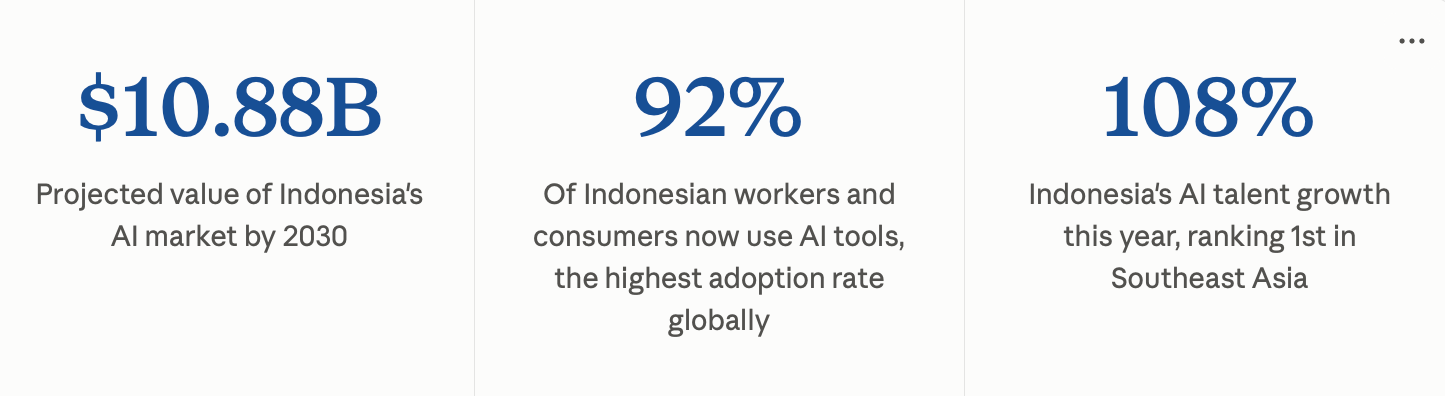
If we look closely, Indonesia is also a fast-growing base of AI users, with adoption spreading across enterprises, creative, and everyday consumer applications. About 92% of Indonesian workers and consumers now use AI tools, the highest adoption rate globally, with the market projected to reach $10.88 billion by 2030, Introl reported.
The talent side is also backing this up. According to the Stanford AI Index Report, the country recorded 108% AI talent growth this year, ranking 6th globally and leading Southeast Asia.
DailySocial’s 2026 Startup Report highlighted AI is weaving itself into the background of almost every industry. In consumer tech, according to the report, companies are using AI to predict what customers would buy next or to manage inventory. They see it as efficiency gains to keep profit margins alive. Meanwhile in the B2B side, AI is taking over the daily routines and operations, from customer support, workflow automations, including data-driven decision making.
From capacity to building what comes next
“AI infrastructure has now become a core foundation of the digital economy,” said Aziz Aluthman Fakhroo, Group CEO of Ooredoo Group, in the official release of Zankore. The Zankore’s project is confidently set to strengthen Indonesia’s position as a regional AI hub, an implication that may reach beyond the AI sector alone and also may attract venture appetite across adjacent sectors.
What we see from that combination of a large digital user base and rapidly expanding AI talent creates an important foundation for the next stage of ecosystem development. It may point to rising demand for domestic AI products with sufficient computing infrastructure.
In a broader lens of ecosystem-building, it may potentially become a catalyst for the nation’s AI ecosystem, giving us capacity that opens the door for more AI-native startups to build locally instead of relying on infrastructure hosted outside.
According to Mordor Intelligence, Indonesia’s AI Data Center market size reached US$0.66 billion in 2025, and is estimated to climb to US$1.44 billion by 2040, a 16.91% CAGR. Strong sovereign AI policy, hyperscaler capital inflows and strict data-localization rules are keeping the growth curve steep.
The bigger picture is that Indonesia’s AI ecosystem could move from being primarily an application/user market toward an infrastructure-and-development market. The country would have the capacity to build, train, and scale AI solutions locally.
It also reduces dependency on external infrastructure providers, which can be especially important for companies handling sensitive data or operating in regulated industries.
This opportunity is also revealing a much larger regional infrastructure buildout. Per Ember’s report in 2026, Southeast Asia now hosts more than 2,000 data centres across Indonesia, Malaysia, Singapore, Thailand, Vietnam and the Philippines, with hundreds more under construction and over a thousand in the planning stage. Indonesia is now emerging as one of the main host within this regional expansion.
Now, the next chapter is up to the founders, investors, and builders to set what gets build first on this new infrastructure.
***