
We’ve seen lots of Indonesian startups have attracted capital for years now, riding the wave of technology development and digitalisation. Investors of every kind put their trust in, sometimes with capital alone, sometimes through strategic partnerships.
Most of those deals, though, have centered on one instrument: equity. Meanwhile, debt funding has been quietly working its way into the conversation, giving founders another option to match the right capital structure to what their business actually needs.
So what do we actually know about venture debt, and how founders are turning to it as they navigate today’s funding scarcity?
Stay curious,
Foundry Collective
Venture debt 101: A quick refresher
Founders, innovators, builders, if you’re actively raising capital, chances are venture debt, also known as venture lending, isn’t a totally new term to you. It’s worth a refresher, especially if you’re considering your options for external capital. In simple terms, venture debt is a type of private credit financing offered to startups or early-stage businesses.
There’s a lot to weigh when raising capital in today’s challenging global economy leads to prolonged funding scarcity. Venture debt has become a viable option for founders looking to fuel growth and extend runways that match their business model and cash flow.
A few defining traits are worth knowing upfront. First, and this the part most founders already sense intuitively, venture debts lets you raise capital without giving up equity. That’s the key difference from equity funding, which involves selling shares in exchange for cash, and with it, a piece of ownership.
As startups move through different stages of growth, venture debt is structured somewhat differently from traditional bank loans. The terms are designed to reflect the growth stage, including higher interest rates that account for the nature of the lending. Here’s a quick breakdown:
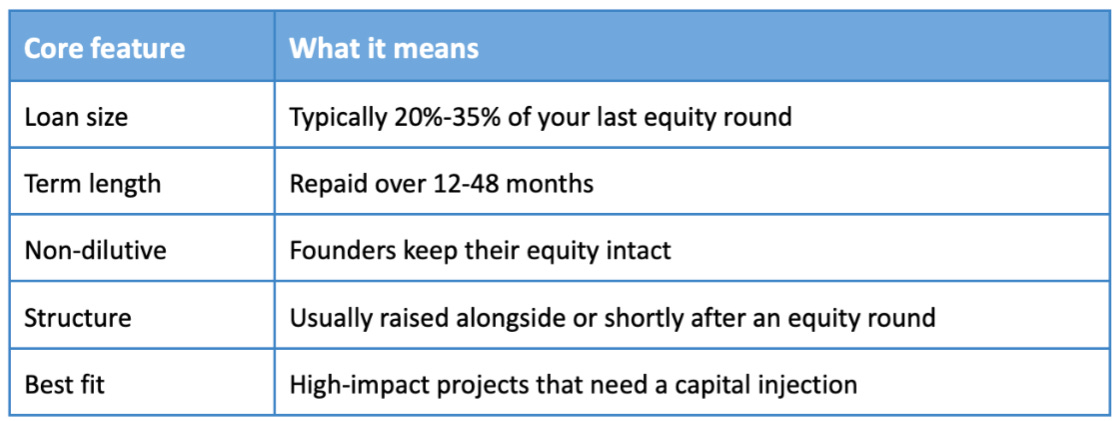
So when does venture debt actually make sense? There are three common scenarios, according to Jakarta Ventura:
🛣️ Extending runway: when a company does need more time before it’s ready for its equity round (Series A, B, and beyond).
⬆️ Funding short-term expansion: for things like entering a new market or accelerating product development
🌱 Supporting post-investment growth: right after closing a venture capital round, to build on that momentum
This explains how venture debt typically is being raised alongside equity, as part of a blended capital structure rather than a standalone. Its role is supplementary: stretching available capital further while easing cash flow pressure, calibrated against how far along the startup actually is.
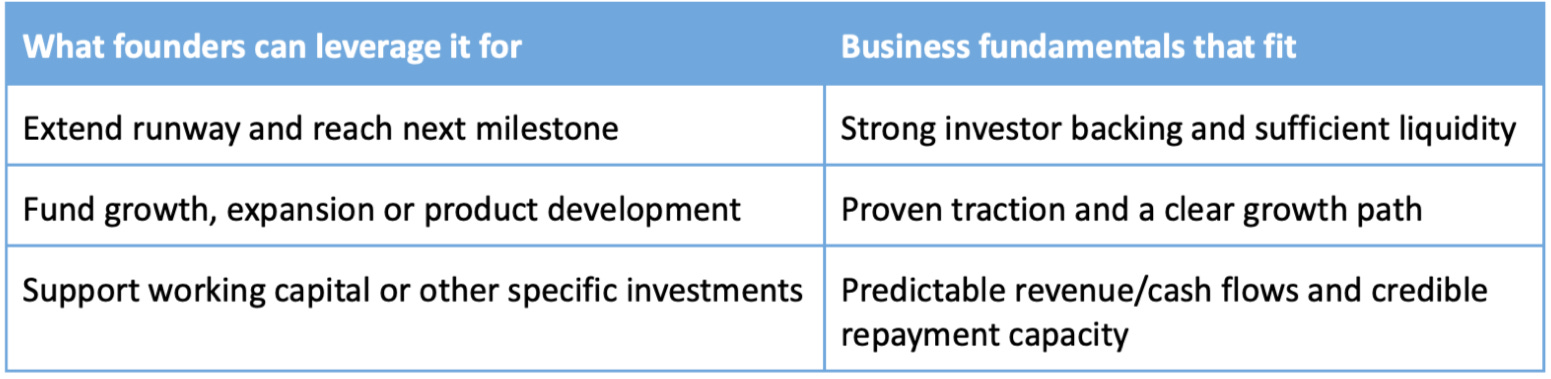
And, that also raises a practical question: beyond extending runway, where can venture debt add value for founders, and what kind of business fundamentals make it a suitable fit?
Budget hotel platform RedDoorz’s funding history is a good example. In January 2016, the company raised US$1.4 million in pre-Series A round from 500 Startups, then followed it up in April 2017 with US$1 million in venture debt from InnoVen Capital. This fits the scenario for how a venture debt often enters shortly after an equity round.
But, in other cases, startups have raised both in one go, a single round combining equity and debt together.
Where the capital’s headed: A growing footprint
Venture debt has become an established financing tool for venture-backed startups in mature markets, particularly in the US. It’s no longer treated as the last option for companies that couldn’t raise equity.
According to Silicon Valley Bank, US venture debt deal volume has grown at an average annual rate of 17% since 2014, while the average deal size climbed from $20.4 million in 2020 to $46 million in the first six months of 2024. This reflects how more mature startups increasingly turned to debt to extend their runway and hold onto more of their equity.
That maturity has not fully carried over to Southeast Asia, at least not yet, due to some common obstacles. For instance, the limited investor appetite and a scarcity of high-quality deal flow, constrain how venture debt providers’ can scale in the region, citing Fintech Nation.
But the data suggests that the gap is closing gradually. To give a brief overview, a report shows that venture debt deal-making across the region has shown a steady upward trajectory in over five years. Much of that momentum traces back to the situation where the funding squeeze began in around 2022. As interest rates climbed and equity checks became harder to secure globally, including Southeast Asia, founders who once treated debt as a last resort, started to consider it far more seriously.
In Indonesia specifically, venture debt is gaining ground, with Statista Market Insights estimating the country’s market to reach approximately IDR3.23 trillion.
Who actually issues these loans? Mostly venture debt lenders, venture capital firms, private equity, and other alternative asset managers. Here we have Qverse, a venture debt firm anchored by former Bukalapak chief Achmad Zaky, who also founded venture capital firm Init6.
Banks are in the mix too. OCBC NISP, for instance, offers venture debt through its investment arm, OCBC Ventura. The firm backed coffee chain company Kopitagram with $4 million debt.
Not replacement, a complement
Founders now have more room to design their own capital stack. Venture debt costs less in ownership, but comes with a fixed obligation equity doesn’t carry. Equity costs more in dilution, but shares the risk if things don’t go as planned.
Darryl Ratulangi, Managing Director at OCBC Ventura, sees this trend unfold, according to his interview with DealStreetAsia last year. “We observe a growing trend of startups utilising debt financing to minimise dilution. However, we believe debt solutions are most effective as complementary to equity injections or as a bridge to future equity rounds. While debt financing offers advantages, it cannot fully replace equity capital.”
So, which sectors are pulling the most capital in Southeast Asia and Indonesia, and what does it signal for founders weighing their next raise? Stay tuned with deeper coverage in the next piece!
***